

Almost every device sold in India has a GMS certificate. OEMs have been opting for it because it provides a layer of authenticity to their device and enables basic features we take for granted - syncing calendar contacts, message database between devices, Drive or use Google search or Assistant.. GMS is where Google makes money since AOSP (Android Open Source Project) is free. As part of GMS, Google has time and again promoted apps which are beneficial to them other than search, maps, etc. Even Google Duo is part of GMS!? Playstore is an integral part of GMS since the beginning. Other than that, OEMs are allowed to only pre-load their own appstore, so other than google playstore, the google policy dictates that other players can't become significantly big enough. They will be only as large as the largest OEM (ie 15-20%). eg- Mistore, Galaxy store, etc You can read more about GMS here: https://bit.ly/2ZXORps
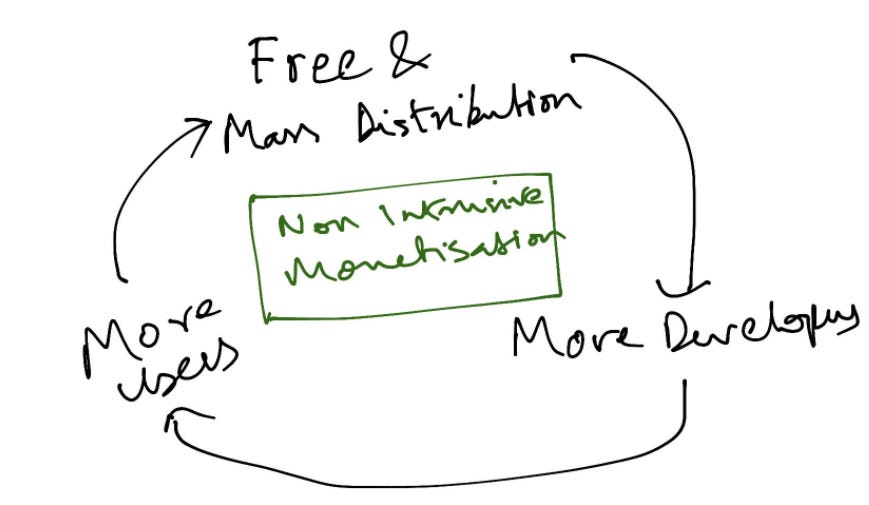
Since it has monopoly in distribution and universal presence, playstore attracts maximum developers to its platform. A developer would want to list his app on one platform which everyone uses and can make it free for download. More developers means more apps, more apps means more options for users and the flywheel sets in. A user typically wants as many choices as possible and Playstore thus becomes the preferred choice for downloading apps. Other than flipkart, amazon, paytm, gpay, etc., she will also install an app for playing ludo, changing wallpaper, etc.
Do not want to skip mentioning the plethora of adult apps which are present in a disguised state on the Playstore. What do you think the burgeoning internet base in India is using?
Direct downloads are still very costly and skipping playstore comes at a cost. Organic discovery stops and updates remain a problem plus continuous security threats come on a user device. But a normal user is not much concerned about security threats though (at least in India).
Have you seen D11 billboards this IPL - they specifically talk about downloading the app from dream11.com. Just want to mention that apk transfer (previously via Shareit) also constituted a large chunk of downloads.
Also, Playstore further excels in its monetisation model:
- Freemium model
- Nominal fee for developer to onboard
- Indirect Revenue via ads on Playstore
- Most importantly, Google Search and Ads Business drives revenue for app installs
- Most of the playstore charged on CPM/ CPI/ CPR/ CPS (Cost per mil/ install, registration/ sale) and while Google has made at least the download part free and makes revenue from other sources.
Goliaths are left on David's own turf ie., advertising. The chances of this Goliath succeeding is very low!
PS - I have led the appstore business for Cube26, a start-up co-funded by Flipkart and Tiger Global and acquired by Paytm and we built android customisations as well as white-labelled appstore for OEMs.